AI Chipmakers Slump as Data-Center Politics Go National
Democrats' sweep adds a new gate to the AI buildout, on top of cash-flow doubts and scarce power. Thursday's selloff was the market pricing that permission into the trade that carried the bull run.
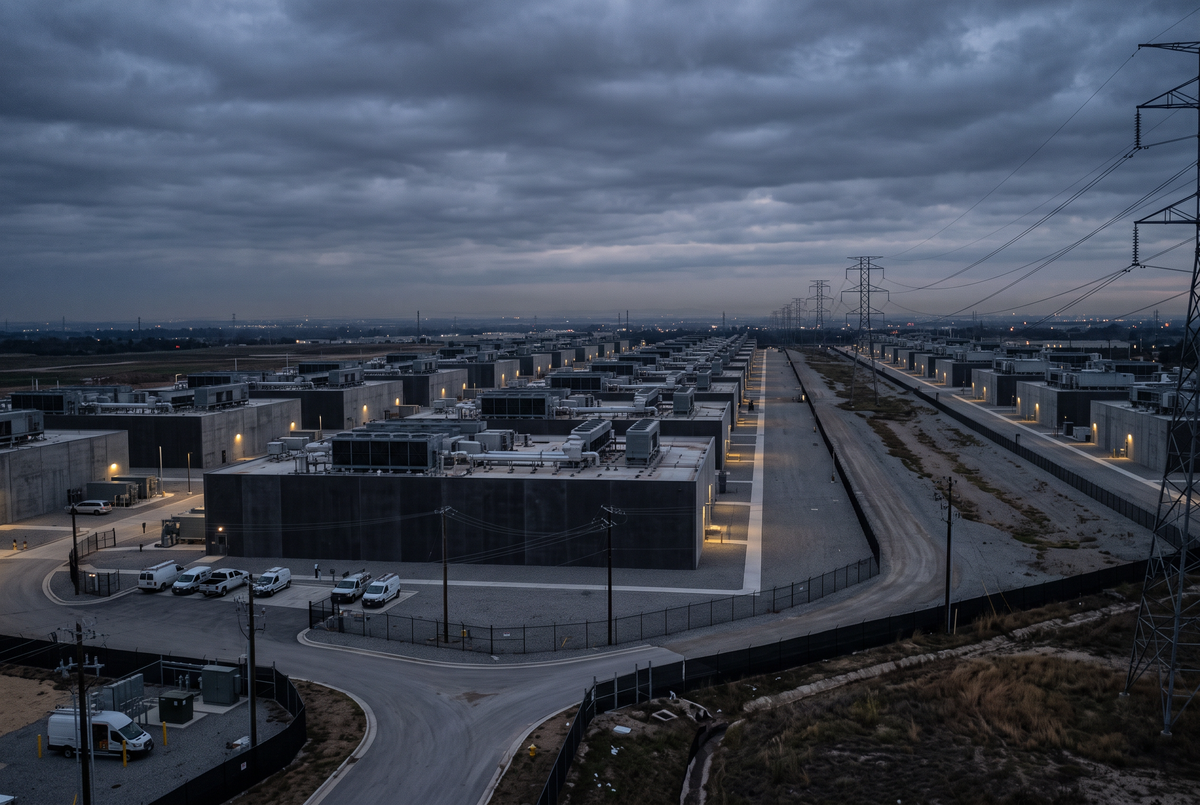
Investors spent Thursday dumping the AI complex that has carried the bull market, and they did it with a new constraint in view. Democrats won control of both the House and Senate in Tuesday's midterms. The tape then treated data-center construction as a political and regulatory risk, layered on top of the cash-flow and overspending concerns already hanging over hyperscalers.
The S&P 500 fell 4.4%, its worst day since the April 2025 "Liberation Day" tariffs. The Dow Jones Industrial Average sank 1,833 points, or 3.4%. The Nasdaq composite tumbled 5.5% and closed 11.9% below its all-time high. The Philadelphia semiconductor index fell as much as 11% intraday, its worst since March 2020. The Nasdaq's record close was October 6.
The session erased $2.3 trillion in market value, and the VIX volatility index rose 70% to 28. Nvidia lost 9.3%, AMD 17.3%, Micron 17.5%, Broadcom 10.4%, Tesla 10.8%, and Microsoft 3.6%. Neocloud names were hit hard: Nebius fell 15%, Iren 17%, and CoreWeave 10%. Friday brought a partial rebound, with the S&P 500 up 1% and the Nasdaq up 1.9%, while the Dow slipped 0.4%.
City halls were already slowing the buildout
The election added a Washington overlay to a fight that was already local. Dozens of ballot measures in 10 states were up for a vote Tuesday that would restrict data-center construction in different ways. Research from the think tank International Data Center Authority found that between January 2024 and May 2026, at least 46 AI data-center projects across 20 US states, representing more than $170 billion in announced investment, were blocked, withdrawn, or stalled following community opposition.
That stalled slate sits against a still enormous spending plan. Goldman Sachs estimates AI-related capital spending could total about $7.6 trillion from 2026 through 2031, across computing, data centers, and power. The industry still wants to spend. The market is now pricing whether that slate can get built, powered, and permitted on a political timetable.
A slower race, with the advantage at the top
The tension inside the trade is real. One camp reads moratoriums and ballot measures as a structural slowdown in US capacity, a hard cap on the physical plant behind those spending plans. The other camp argues that data centers can relocate abroad, and that a government-imposed brake could even help hyperscalers by cooling an arms race that was already scaring investors on cash flow.
Barclays' Dominique Toublan, who covers US credit strategy, put the power constraint in credit language: "The AI race shifts from a prisoner's dilemma to a war of attrition: scarce power favors the biggest balance sheets." Permits point the same way. Firms that can wait out a local fight and fund a multiyear queue can live with a slower US pipeline. Dan Ives of Yorkville Ives & Co. now sees big-tech capex growth peaking in 2027, versus a previous view of 2028 or 2029. That pulls the peak forward.
A strong jobs report left the AI question intact
Friday's labor report did not look like a growth scare. US employers added 165,000 jobs in October, far above the roughly 65,000 economists expected, and the unemployment rate dipped to 4.1%. The bounce in the Nasdaq fit a market that had overshot on Thursday. It did not restore the assumption that every announced US campus gets built on the original schedule.
The clean read is a stacked constraint. Hyperscalers were already being asked to prove that AI spending will turn into cash. Power was already scarce. A Democratic Congress, plus a thicket of local opposition, adds a third gate: permission. Some projects will move. Some will slip. The firms with the strongest balance sheets can treat a slower US queue as a filter. Thursday was the session where that uncertainty showed up in the language the bull market had been using, which is the AI multiple.