Evolution Metals Is Building for the Premium End as the Rare Earth Race Heats Up (NASDAQ: EMAT)
 Sponsored · Market Discovery Content
On November 4, Solvay announced a long-term agreement to bring Brazilian rare earth feedstock to its processing plant in France, with shipments expected from 2028. The deal connects a resource in one country with the industrial expertise in another needed to turn it into useful materials.
For Evolution Metals & Technologies (NASDAQ: EMAT), the commercial opportunity lies further along that chain: turning rare earth materials into magnets that perform inside demanding machines. The U.S.-based manufacturer already sells magnets from South Korea and is installing equipment intended to expand that business substantially.
The distinction matters because a tonne of rare earth material can pass through several businesses before it becomes a component a motor manufacturer can use. Separation produces individual rare earth oxides. Metal and alloy production prepare the ingredients. Magnet manufacturing turns them into a product with specified magnetic strength, heat resistance and physical dimensions.
The value of that finished product depends on what it can do. Evolution Metals is building toward a part of the market where performance carries a premium.
Heat Resistance Changes the Economics
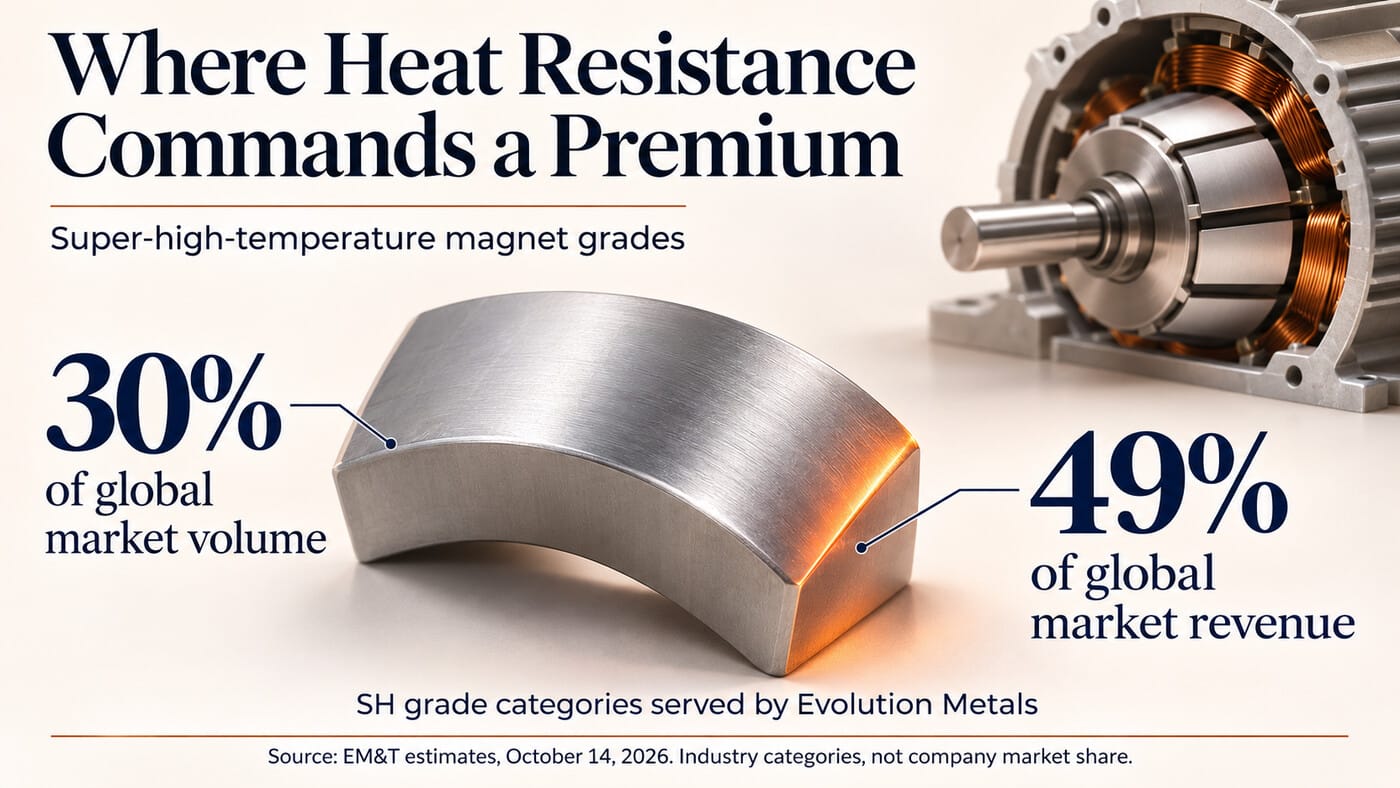
In its October 14 product update, Evolution Metals estimated that its four super-high-temperature magnet grades address categories accounting for approximately 49% of global sintered neodymium-iron-boron magnet revenue on 30% of volume. Sintering uses heat to consolidate pressed powders into a solid magnet.
That industry mix implies estimated average revenue per tonne about 1.6 times the market-wide average, calculated by dividing 49 by 30. The figures describe the grade categories Evolution serves; its opportunity is to win business within them as production expands.
The company rates these grades to 150 degrees Celsius and identifies applications including electric-vehicle traction motors, wind generators, aerospace equipment and defense actuators. These are machines where maintaining magnetic performance under heat helps determine which component the customer can specify.
Customer Qualification Gives the Expansion a Starting Point
Evolution's subsidiaries completed customer quality certification with two global Tier-1 electronics manufacturers across six magnet grades in June, including high-temperature compositions. The company said those certified grades were being produced at commercial scale.
Its October 28 Army submission provides a specific example of how existing products can open another commercial route. The Army sought N52SH or N42SH magnets for small drone motors. Evolution already commercially produces customer-qualified N42SH at Pohang and proposed further testing against the Army's requirements. The process remains market research, with application-specific qualification and procurement still ahead.
Together, those developments give the expansion something tangible to build on: products that have passed customer procedures, manufacturing experience and a relevant grade already being sold. Each additional application creates a route to pursue as the factory adds output.
For a manufacturer, that breadth can matter commercially. Customers choose a component for a particular design, and a portfolio spanning different operating conditions creates more opportunities to compete for those specifications. Scaling qualified products could therefore broaden the business across several end markets.
More Machines Can Put the Product Mix to Work
On October 28, Evolution confirmed that all 57 containers of additional ULVAC equipment had arrived at Pohang. Management said assembly and commissioning were under way. Following installation and commissioning, the expansion targets approximately 10,000 metric tons of annual magnet capacity, including approximately 6,000 tons of high-performance sintered magnets, from a total base near 1,000 tons.
The next day, Evolution reported approximately 754 metric tons of secured non-China neodymium supply across delivered, pending and committed shipments. Management expects that material to cover about half the estimated feedstock for its 2027 revenue guidance. The company also continues to source from China, giving its business a mix of inputs for different customer requirements.
Management's outlook calls for $400 million to $460 million of revenue in 2027, based on anticipated customer demand rather than contracted volumes. Achieving that scale depends on commissioning, customer orders, feedstock and working capital; the latest quarterly filing identifies additional financing needs. The commercial foundation is an operating business with products, customers and expansion equipment already on site.
Solvay's agreement shows how companies are connecting resources and processing capacity across borders. Finished magnets are another essential link. Evolution's December 17 operational showcase offers the next scheduled look at Pohang. As commissioning progresses, the combination of greater output and a portfolio aimed at demanding applications could make its manufacturing business an increasingly consequential part of the rare earth story.
Recent News Highlights from Evolution Metals (NASDAQ: EMAT)
Evolution Metals & Technologies Secures Approximately 754 Metric Tons of Non-China Neodymium Metal…
The Finance Herald newsletter
Get The Finance Herald in your inbox
Markets, deals and the under-the-radar stories moving them. Free, unsubscribe anytime.