MasTec Pays $1.25 Billion for the Labor That Keeps Data Centers Running
MasTec is buying Murphy Corporation, a 119-year-old family mechanical contractor, for about $1.25 billion in cash. The deal is a bet that the next phase of the AI buildout is the trades that keep facilities running, not the chips inside them.
MasTec has agreed to buy Murphy Corporation for approximately $1.25 billion in cash, according to a definitive release published on November 20. Murphy is one of the largest mechanical contractors in the United States, a business founded in 1907 and continuously family owned and operated for more than 119 years. It stops being a family business the moment the paperwork closes.
The price works out to roughly nine times Murphy's projected 2026 Adjusted EBITDA of about $140 million, on projected full-year revenue of about $775 million. MasTec is funding the purchase with a bank term loan arranged at the same time as the agreement. The company carried $4.19 billion of total debt obligations at September 30, up from $2.35 billion at the end of 2025, per its quarterly filing, and it estimates pro forma net leverage of 2.7x, with further deleveraging expected to take that below 2.0x during 2027. Management expects the deal to be immediately accretive to revenue, Adjusted EBITDA, earnings per share and cash flow from operations. Substantially all conditions to closing have been satisfied, so the wait should be short.
Buying crews, not blueprints
What MasTec gets for the money is mostly people. Murphy has about 1,600 employees, including roughly 1,200 union craft professionals, the kind of workforce that cannot be hired into existence quickly when every large contractor is bidding for the same skilled trades. Its customers sit in aviation and defense, healthcare, pharmaceutical manufacturing, technology, food processing, refrigeration and advanced manufacturing, and the business delivered double-digit growth in both revenue and EBITDA for the two years ended March 31, 2026.
Jose Mas, MasTec's chief executive, framed the fit plainly: "Murphy expands MasTec's capabilities in some of the fastest growing and most diverse infrastructure markets in North America." Murphy will operate as a new group inside MasTec, is expected to report within the Clean Energy and Infrastructure segment, and its management team under President and CEO Patrick Murphy stays in place. Continuity is the point. The asset being acquired is largely the relationships and the crews that come with them.
The annuity behind the headline
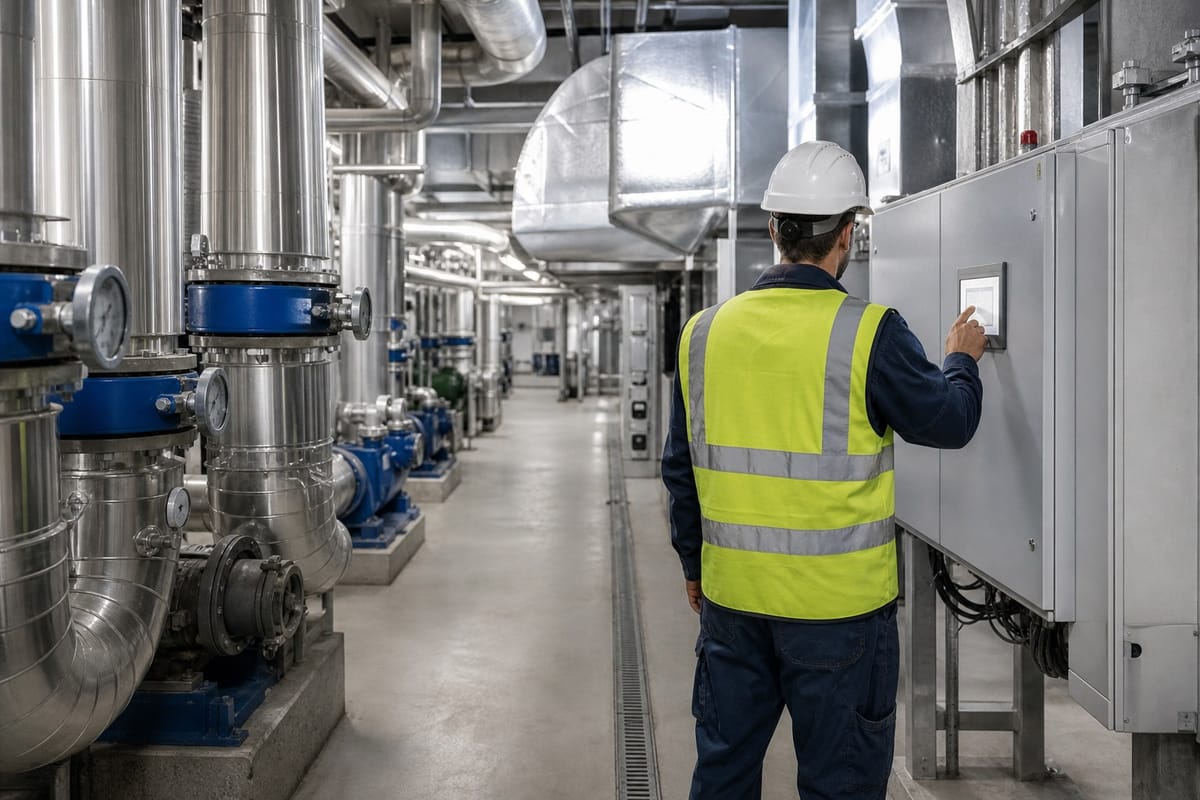
The least discussed part of the deal may be the most valuable. Beyond construction, Murphy runs a service and maintenance business providing recurring HVAC, plumbing, refrigeration and controls work to mission-critical facilities. The release says MasTec sees growth there as data centers and other large-load facilities move from construction into ongoing operation. A building is erected once and then serviced for decades, and that turns a project business into something closer to a subscription. Contractors usually trade at cyclical multiples for exactly this reason: the work stops when the building does. A maintenance book does not.
The order book explains the timing
MasTec did not need help looking busy. Its third-quarter results showed record quarterly revenue of $5.2 billion, up 30% year over year, and Adjusted EBITDA of $486.4 million growing at a similar pace. The record 18-month backlog stands at $24.5 billion, up $7.8 billion from a year earlier and $3.2 billion from the prior quarter, led by 74% year-over-year growth in Power Delivery backlog, the segment that serves utilities in transmission, distribution and large load electrical infrastructure.
Full-year 2026 adjusted diluted EPS guidance was raised to $8.92 to $9.30, a 39% increase at the midpoint. MasTec runs four segments, Communications, Power Delivery, Pipeline Infrastructure and Clean Energy and Infrastructure. Each one is downstream of the same demand: electricity and large facilities being built faster than the labor pool that serves them is growing.
What the multiple admits
Nine times EBITDA is a serious price for a contractor, and the earnout tied to Murphy's three-year performance means the sellers can still be paid more if the business outperforms. The debt taken on to fund the purchase raises the stakes on execution, particularly if the construction cycle turns while the new group is still being integrated.
But the arithmetic reads differently if the buyer is right about where the industry's center of gravity sits. Much of the first wave of the AI buildout went to chip designers and the developers who leased them space. The next belongs to whoever can staff, install and then maintain the mechanical and electrical systems those buildings cannot run without. MasTec is paying nine times earnings for a roster of union tradespeople and the service contracts that follow them. The price is the argument.