Why the Liver Test Became the Real Contest in a Rare Joint Tumor
A third oral drug for a rare joint tumor cleared the FDA with the highest response rate yet and no boxed liver warning. In a market measured in thousands of patients a year, the label may matter more than the trial result.
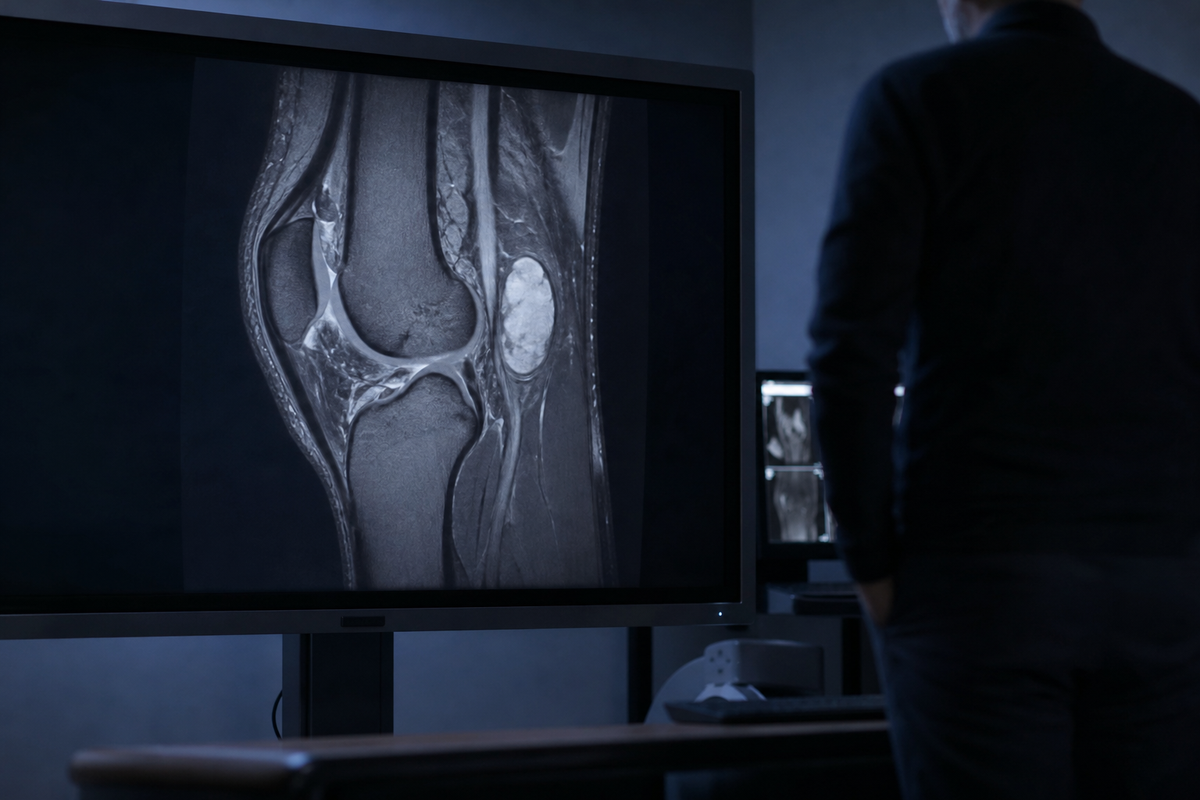
Tenosynovial giant cell tumor spent decades with surgery as its only real option. In seven years it has gone from zero approved drugs in the United States to three oral ones. The newest, EMD Serono's Pimjetmi, won FDA approval on Nov. 10 for adults with symptomatic TGCT, where surgical resection may cause worsening functional limitation or severe morbidity. It is a once-daily inhibitor of CSF-1R, the colony stimulating factor-1 receptor, taken at 50 mg.
The approval closes a licensing arc that started three years earlier. In December 2023, Merck KGaA paid Shanghai-based Abbisko Therapeutics a $70 million upfront for an exclusive commercial license covering mainland China, Hong Kong, Macau and Taiwan, with an option on the rest of the world. That release noted no approved TGCT drug in China then, and only one in the United States. Merck KGaA now holds worldwide rights, and the approvals stacked in China in December 2025, Canada in June 2026, Switzerland in October 2026 and the US inside eleven months. Pimjetmi also holds a PRIME designation from the European Medicines Agency.
The numbers behind the label
In the MANEUVER trial, 94 patients were randomized 2:1 in the double-blind portion, 63 to pimicotinib and 31 to placebo; the primary endpoint was overall response rate at Week 25 by blinded independent central review under RECIST v1.1. The response rate came in at 56%, with a 95% confidence interval of 42 to 68, against 3.2% on placebo. Median duration of response was not reached. Of 32 responders, 91% held their response for six months or more and 77% for twelve months or more.
Those figures sit above the two drugs that came before. Turalio, approved in August 2019 as the first FDA therapy for the disease, posted a 38% response rate across a 120-patient trial in which 59 received placebo, with a 15% complete response rate. Romvimza, approved in February 2025, reached 40% in the MOTION trial of 123 patients against no responses on placebo. Three separate trials, none of them head to head, so the ordering is directional rather than definitive.
Where the competition actually lives
The more consequential difference sits in the liver. Turalio's label carries a boxed warning for hepatotoxicity, including serious and potentially fatal liver injury and vanishing bile duct syndrome, and the drug is available only through a restricted REMS program. Of the first 609 patients treated under it, 32 developed a liver injury event of concern, a rate of 5.3%. Ten of those patients required hospitalization, two developed vanishing bile duct syndrome, and 16 had not fully recovered at the analysis. The dosing adds its own friction: 250 mg twice daily with a low-fat meal.
Romvimza lists hepatotoxicity in its warnings and precautions, with liver tests twice a month for the first two months and every three months through the first year, but no boxed warning. Its schedule runs the other way, at 30 mg twice weekly with at least 72 hours between doses. Pimjetmi carries warnings for hepatotoxicity, embryo-fetal toxicity and increased serum creatinine without affecting renal function, and no boxed warning either. Its most common adverse reactions above 20% were pruritus, rash, face and periorbital edema, fatigue, nausea, headache and peripheral edema, and its schedule is a daily pill.
EMD Serono, which filed the application, reports that MANEUVER showed no evidence of cholestatic hepatotoxicity or hair and skin hypopigmentation, that treatment-emergent events led to discontinuation in one patient, or 1.6%, and that 7.9% of patients had a dose reduction. Those are company figures rather than FDA findings and regulators weigh them separately, but the shape of the label is what prescribers read.
A market measured in thousands
The addressable population is small. A Danish registry covering 1997 to 2012 put the incidence of localized TGCT at 30.3 per million person-years and the diffuse form at 8.4 per million person-years. TGCT is a benign tumor arising in or around joints that causes pain, swelling, stiffness and reduced mobility, and the diffuse form is the one that most often needs systemic therapy. At the Danish rate, the United States would see only a few thousand new diffuse cases a year, which is the pool a daily oral drug competes in most directly.
In a market that thin, the competitive axis has moved from proving that a response exists to the safety label and the dosing rhythm. Pimjetmi now has the best response rate of the three, a liver warning short of a boxed one, and the simplest schedule. Whether that converts into share against an established Romvimza and a REMS-burdened Turalio will play out in clinic formularies, in payer decisions on three drugs for the same small population, and in how the monitoring burden reads to physicians who rarely see the disease.
Merck KGaA has slotted Pimjetmi into a rare-tumor franchise that already includes OGSIVEO, approved for progressing desmoid tumors. The FDA review ran under Project Orbis with regulators in Australia, Canada, Israel, Switzerland and the UK, and the European Medicines Agency as an observer; those partner reviews are still in progress.