ABB Pays a Premium for the Fans That Drain a Data Center's Power
ABB is paying 18.6 times EBITDA for Ziehl-Abegg, a family-owned fan maker that earns mid-single-digit margins, because a fan sets roughly 80 percent of a cooling system's lifetime power use.
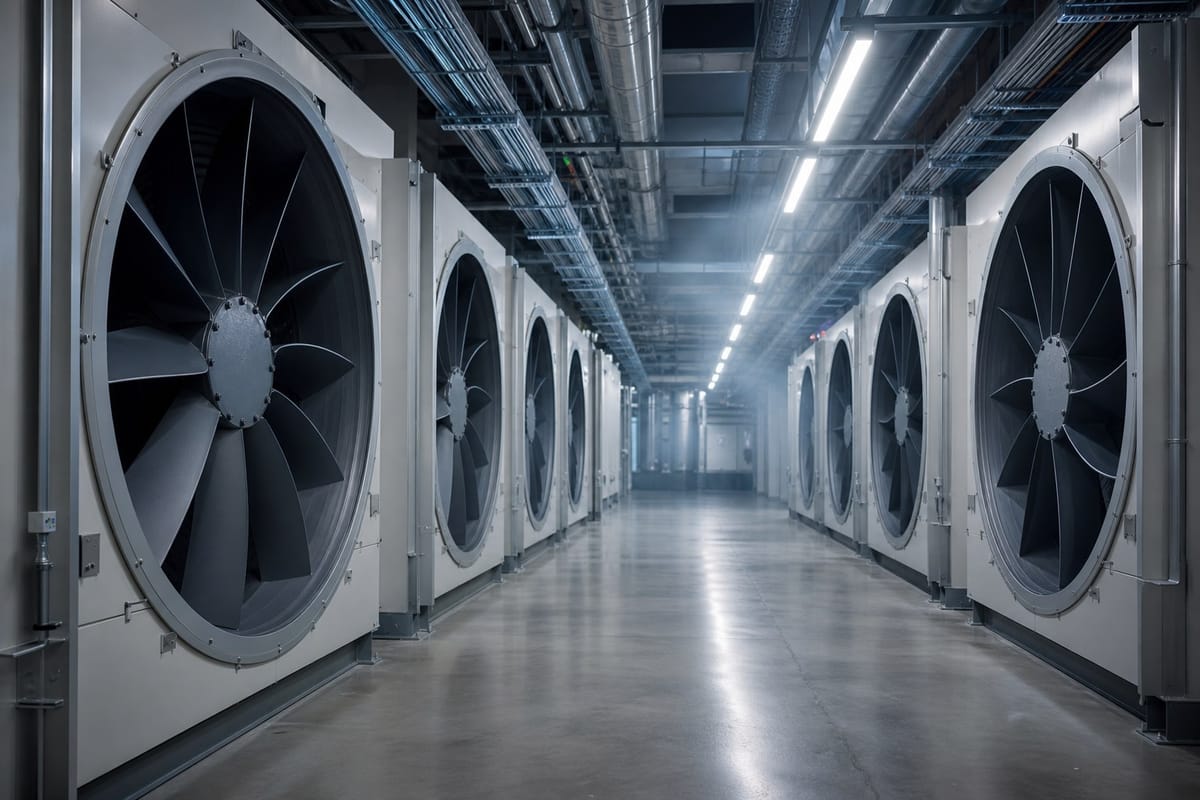
ABB will pay $2.65 billion for a company whose product is a minor line in a cooling system's capital budget and the dominant line in its electricity bill. The agreement to acquire Ziehl-Abegg, the German fan and drive maker, carries an enterprise value of $2.65 billion and an equity value of $2.22 billion, according to the release. Ziehl-Abegg is family-owned, unlisted and based in Künzelsau, Germany, with around 6,300 employees.
ABB expects roughly $1.4 billion of revenue from it in 2026 at an Operational EBITA margin in the mid-single digit range, with closing anticipated in the second half of 2027 subject to regulatory approval. The price works out to 1.9x sales and 18.6x EBITDA on the year ending 2026, and ABB expects the EBITDA multiple to fall toward low double digits once mid-term synergies are included.
The rationale sits in a figure further down the same announcement: a fan typically represents around 5 percent of the capital cost of a cooling system but accounts for around 80 percent of its lifetime energy consumption. Ziehl-Abegg's fans serve HVAC, data centers, clean rooms, medical technology, industrial processes, agriculture and elevator drives.
The margin the price has to fix
Ziehl-Abegg does not disclose earnings. Its 2025 revenue exceeded one billion euros for the first time, up from EUR 893 million, growth of more than 12 percent. Chief executive Joachim Ley said in that release that profit came under massive pressure "due to global disruptions."
ABB's remedy is internal. It expects Ziehl-Abegg to reach an Operational EBITA margin broadly in line with its Motion business area average within three years after closing. Motion reported third-quarter revenue of $2,320 million and Operational EBITA of $449 million, a 19.1 percent margin, down from 20.1 percent a year earlier. On $1.4 billion of revenue, moving from mid-single digits to 19.1 percent would add more than $150 million of annual operating profit. That is arithmetic on disclosed figures, not a forecast, and the clock starts at a close ABB does not expect before late 2027.
Brandon Spencer, president of ABB's Motion business area, said Ziehl-Abegg is "highly complementary to our existing portfolio of motors and drives." The target also brings a supply chain argument: proprietary ferrite-magnet technology reduces dependence on rare earths, and in 2025 the company said it was first worldwide to build an electric synchronous elevator machine without them.
Two multiples, one month apart
ABB announced a joint venture with Mitsubishi Electric's low-voltage power distribution business when it published third-quarter results on 20 October: a controlling 51 percent stake for total consideration of around JPY 79 billion, about $495 million, valuing the combined businesses at an enterprise value of about $890 million, or EV/Sales of about 1.4 and EV/EBITDA of about 11.1 on reported fiscal 2025. Orders that quarter were $12,055 million, up 40 percent, and chief executive Morten Wierod credited gains in two of three business areas, "most notably so in the data center segment where we saw a triple-digit increase." ABB had also announced the Rotork acquisition in July.
Ziehl-Abegg prices at 18.6x EBITDA against the venture's 11.1x. The gap holds only if the margin path does: the target's chief executive said profit came under massive pressure in a year when revenue grew more than 12 percent, and the acquirer's own Motion margin slipped in its last reported quarter.
What the fans plug into
Data centers accounted for around 1.5 percent of the world's electricity consumption in 2024, or 415 terawatt-hours, and the IEA expects that to more than double to around 945 TWh by 2030. In the United States, data centers account for nearly half of electricity demand growth to the end of the decade. The agency also estimates that, unless grid risks are addressed, around 20 percent of planned data center projects could face delays.
Ziehl-Abegg arrives with a footprint. The United States is now its most important foreign market at well over 20 percent of revenue, China is second and intensely competitive, and the company opened a EUR 100 million US manufacturing and R&D hub in 2024 before launching a separate EUR 90 million capacity program in 2026 across Europe, North America and Asia. Ley described "unprecedented investments across our global footprint to meet surging customer demand."
The week the AI trade buckled
The deal landed in a soft tape. A sell-off of artificial intelligence stocks pulled the S&P 500 down 3.7 percent on Friday, into correction territory. ABB is buying deeper into AI-adjacent demand in the week that demand got repriced in public markets.
That does not make the deal wrong. A component that sets 80 percent of a system's lifetime power draw is a coherent thing to own, and ABB has the installed base, channels and electrical architecture to sell it into. What the price buys is a repair job: a business that grew revenue by double digits without converting it into profit, at a multiple ABB itself expects to look better only after three years of ownership. Those three years, and the late 2027 close, are ABB's own checkpoints, and both are in the price.