Strong Supply, Weak Demand: China's Numbers Now Name Its Problem
China's October data shows exports up 35.2% while retail sales grew 0.4% and fixed investment fell 8.1%. Beijing's own statistics agency and central bank now describe the same problem, and the policy answer is targeted credit for industry.

China's October data finally matches the language its central bank is using. Exports jumped 35.2% from a year earlier to $412.33 billion while imports rose 41.6% to $307.05 billion, leaving a monthly trade surplus of $105.28 billion, according to the customs release. Over ten months the surplus has reached $1.04 trillion, crossing $1 trillion for the second consecutive year.
The domestic picture is far less energetic. Retail sales of consumer goods rose just 0.4% year on year to 4,646.3 billion yuan, up a marginal 0.02% from September, and fixed-asset investment fell 8.1% in the January-October period, with real estate development investment down 21.6% and private investment down 11.4%, per the statistics report. The bureau's own summary named the condition directly: the domestic imbalance between strong supply and weak demand is acute.
That phrase is not a coincidence. Days before the activity data came out, the People's Bank of China used nearly the same words in its quarterly report, saying the economy faces a "strong supply, weak demand" contradiction that remains prominent alongside structural divergence and external shocks. When the central bank and the statistics agency converge on one diagnosis, the gap has stopped being a talking point and become the official description of the economy.
Where the growth actually is
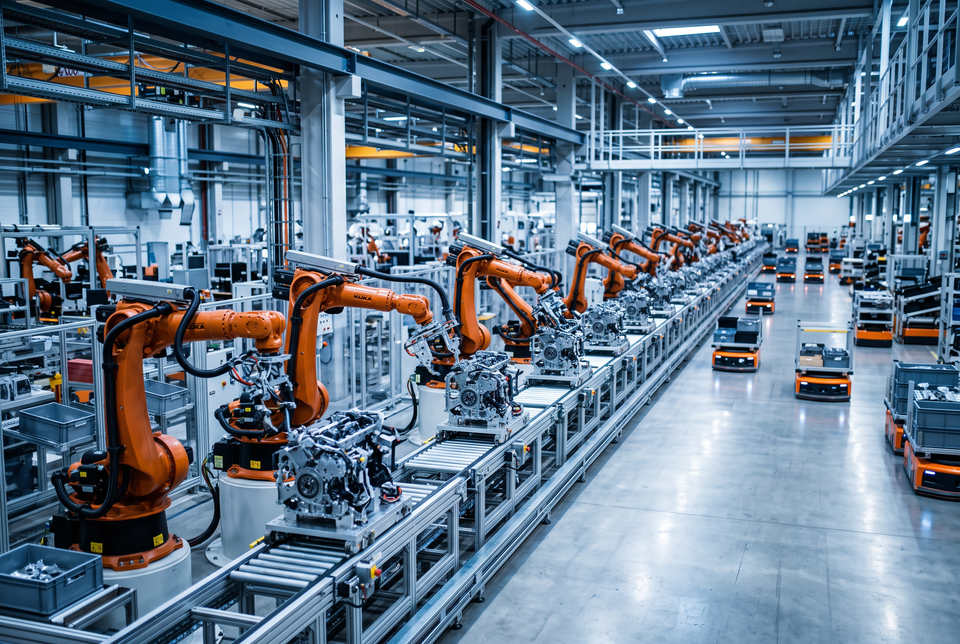
The first three quarters grew 4.6% year on year, and the composition matters more than the rate. Industrial value added at large enterprises rose 4.8% in October, with manufacturing up 5.4% and high-tech manufacturing up 17.6%. Output of 3D printing devices climbed 85.9%, lithium-ion batteries 30.0% and industrial robots 26.0%. Exports of mechanical and electrical products rose 25.2% in yuan terms over ten months, and ordinary trade exports were up 18.1% while exports under processing trade with imported materials rose 20.6%, according to the customs breakdown. The parts of the economy still expanding are the industrial supply chain and the shipping lanes that carry it.
Households sit on the other side of the ledger. January-October retail sales are up only 1.0%. The property market, historically the largest store of household wealth, keeps contracting, with floor space of new commercial buildings sold down 13.7% and sales value down 14.3%, while floor space of second-hand housing transactions online rose 11.4%. Urban unemployment eased slightly to 5.1%. Consumer prices rose 0.7% from a year earlier, and producer prices rose 5.7%, 0.7 percentage points faster than September. Demand is not collapsing; it is barely moving while the supply side compounds.
The policy answer targets producers
The central bank keeps a "moderately loose" stance and lists expanding domestic demand among its priorities. The new quotas it names, though, are aimed at producers and small businesses. Relending for scientific and technological innovation and technological upgrading rose by 200 billion yuan, with the support ratio lifted from 60% to 100%. Relending for agriculture and small businesses increased by 500 billion yuan, including 300 billion yuan more for private enterprises. "Six networks" construction was brought under pledged supplementary lending support, and the central bank cut the rate on that lending by 0.25 percentage point.
The logic is visible in the data. If Chinese factories are taking share in robots, batteries and advanced equipment, targeted credit speeds the winning side. It also accepts the risk the diagnosis implies. Lifting supply without lifting retail demand widens the imbalance the report names, and the difference has to be absorbed somewhere. This year it is being absorbed by the trade account.
The surplus carries the weight
The uncomfortable arithmetic is that external buyers are doing the spending Chinese households are not. October exports grew 35.2% against retail growth of 0.4%, while imports rose 41.6%, and the ten-month surplus still reached $1.04 trillion. A surplus of that size on a consumer base moving at a rounding error is not a windfall. It is the mechanism holding the two halves of the economy together.
The report concedes the contradiction openly. The October numbers show how far the two sides have drifted: an industrial base compounding double-digit growth in its most advanced segments and a consumer base growing at a rounding error. As long as the surplus does the work, the adjustment lands on trading partners rather than on Chinese households. The moment external demand slows, there is no domestic offset waiting behind it.