Data Centers Would Pay for the Grid They Use. The House Has 12 Days to Decide.
The Senate's permitting bill writes into statute that data centers must cover the full cost of the power and grid built to serve them. A lame-duck House with 12 working days left now decides whether it becomes law.
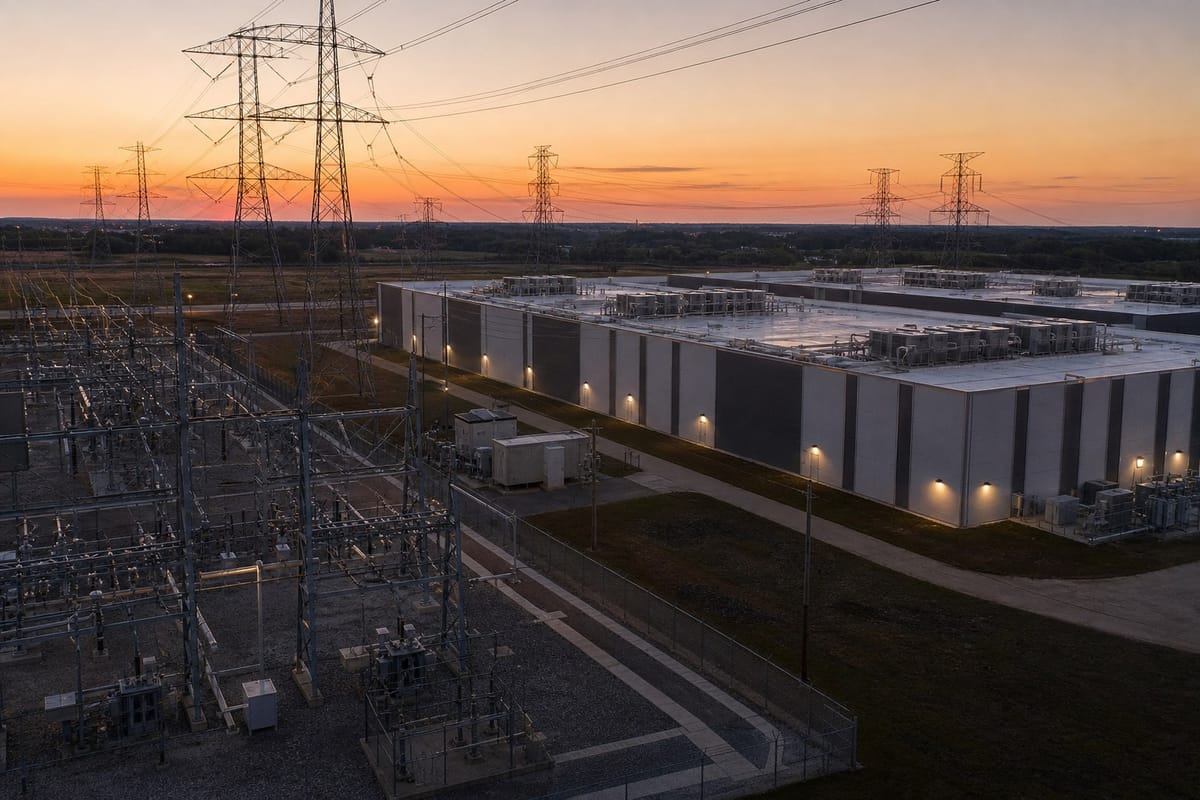
Data centers would be required by law to pay the full cost of the electricity they use and the infrastructure built to serve them, under a provision in the permitting bill the Senate passed on Thursday. The rule reaches from federal transmission pricing to state retail rates, and it resets the cost structure of AI infrastructure with 12 working days left on the House calendar.
The Senate approved the Bipartisan American Affordability and Jobs Act of 2026 on Nov. 19 by a vote of 62-33. The vehicle is H.R. 2347, which the House passed earlier by voice vote under a different title; the Senate replaced that text, so the House now votes on the Senate amendment.
The roll cut across both parties. Forty-seven Republicans, 14 Democrats and independent Angus King voted yes. Only two Republicans opposed it, Mike Rounds and Josh Hawley. Five senators missed the vote. Senate Minority Leader Chuck Schumer voted yes, even though more Democrats voted against the bill than for it.
The provision that changes who pays
The bill runs 417 pages, and most public argument has centered on its permitting machinery: faster reviews, firmer deadlines, limits on litigation. Section 2107 is quieter, and its market consequences are larger. It states as congressional findings that computational load owners should bear the full cost of any electric service they require and any infrastructure built to serve them, so those costs are not shifted onto other customers, including residential ones.
The section directs FERC to revise its 1994 transmission pricing policy statement within 90 days, then issue a proposed rule and a final rule within a year. Utilities would charge eligible computational load customers the embedded cost of transmission plus a FERC-determined assessment of incremental cost, credited against the utility's annual transmission revenue requirement to prevent double recovery from other customers. Loads that elect non-firm service would pay less.
Section 229 sets the retail floor: no portion of the retail incremental cost may be recovered from any customer other than a computational load owner or operator. States may recover more and credit the surplus to other ratepayers, run open seasons to allocate service, require the load to build new generation, and treat data centers as a separate class on less favorable terms. Recovery continues if the load exits before costs are recouped, and utilities must obtain financial assurance before building for it.
What the numbers say
The Rhodium Group modeled the bill and estimates household electricity bills would be $50 to $78 lower a year in 2040 than without it, with prices 0.5 to 1.0 cent per kilowatt-hour lower, a 3 to 5 percent reduction. It projects an additional 17 to 249 gigawatts of clean capacity through 2040, interregional transmission additions 167 to 262 percent higher than the 2015-2024 pace, LNG exports 8 to 15 percent higher than under current policy, and economywide emissions 5 to 148 million metric tons lower annually in 2040.
The same modeling prices the data center rule. Full cost allocation would raise the retail price data centers pay for grid power by 88 to 102 percent, and total annualized capital and operating costs for a 1 gigawatt data center by 10 to 11 percent. Rhodium notes the bill also makes it easier to bring generation and transmission to those loads. The starting point: the US added 0.7 terawatt-miles a year of new high-voltage transmission from 2015 to 2024, 2021 through 2024 were the four slowest construction years since at least 2010, and a median project takes 34 months of environmental impact statement review against 15 for a pipeline.
A 12-day calendar problem
The rest is a familiar permitting fight. FERC must issue construction permits for interstate transmission found necessary in the national interest when states do not act. NEPA lawsuits must be filed within 150 days, with the remedy limited to remand without vacatur. Clean Water Act section 401 review narrows, Endangered Species Act consultation timelines shorten, and sections 1401 and 1402 limit an agency's ability to revoke permits it has issued.
Whether any of it becomes law depends on attendance. Speaker Mike Johnson sent Republicans a letter on Friday urging them back after Thanksgiving, after leadership canceled this week's votes for low attendance. The House adjourned a day early, 32 lawmakers missed Thursday morning votes including 21 Republicans, and at least 12 of those 21 are not returning. Both chambers move to Democratic majorities in January, so a bill the House does not pass this year has to start over.
The White House backs it, saying in a statement of support that the bill "would remove major obstacles to building the infrastructure we need in this country." Rep. Scott Peters of California supports it; House Natural Resources ranking member Jared Huffman urged Democrats to oppose it.
The bet is simple: if the grid gets built faster, the customers who cause the most new load should pay for the capacity they cause. That bet now carries a deadline, 12 working days and a chamber that left town a day early.